AI Visibility Guide
A complete guide to AI visibility, entity clarity, answer optimization, schema, topical authority, and being cited by AI search systems.
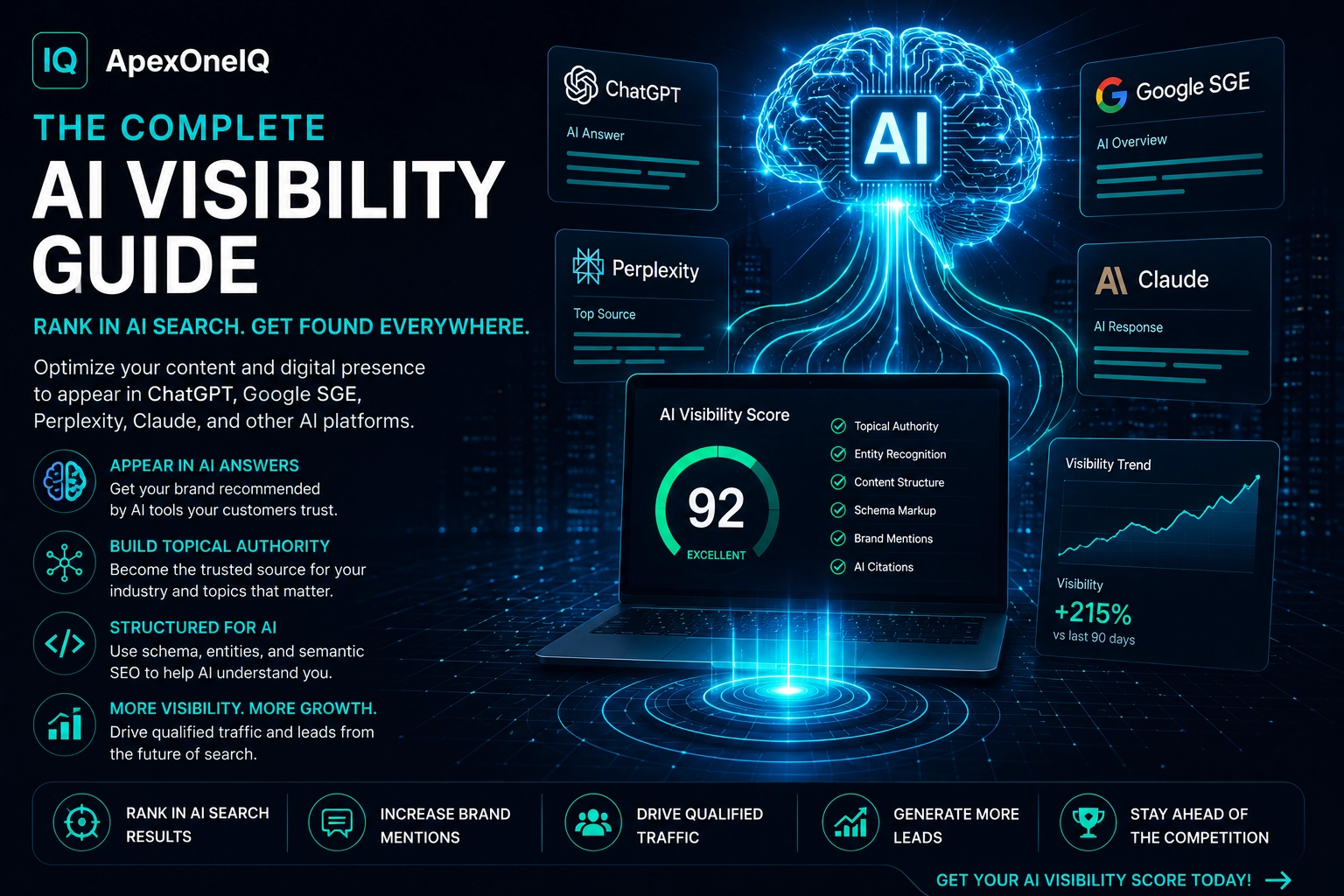
# AI Visibility Guide
Table of Contents
- Introduction
- Why This Topic Matters
- Common Mistakes
- How Google Evaluates This Topic
- Best Practices
- Step-by-Step Implementation
- Real-World Examples
- Case Studies
- Professional Recommendations
- Tools
- Downloadable Checklist
- Frequently Asked Questions
- Conclusion
Introduction
AI visibility is the ability of a brand, business, product, or expert resource to be understood, trusted, summarized, and cited by AI-driven search and answer systems. Traditional SEO still matters, but AI search changes the format of discovery. Instead of only ranking blue links, businesses must become clear entities with useful answers, credible proof, structured information, and consistent references across the web.
ApexOneIQ approaches AI visibility guide as an executive operating discipline rather than a one-time marketing task. The goal is not to create a longer checklist for the owner. The goal is to identify what matters, prepare the work, verify the outcome, and show the business impact in language a decision maker can trust.
A strong ai search optimization program has three characteristics. First, it is measurable. Every recommendation must connect to a visible page, a profile signal, a technical validation, a search behavior, or a business outcome. Second, it is sequenced. Some work should happen before other work because dependencies matter. Third, it is defensible. If an owner asks why ApexOneIQ recommends a change, the answer should include evidence, not opinion.
This guide is written for owners, operators, marketers, and technical teams that want a serious resource they can use to make decisions. It avoids shortcuts and focuses on the systems that help a business become easier to find, easier to understand, and easier to choose.
Why This Topic Matters
AI answer systems prefer sources that are easy to parse, semantically complete, internally consistent, and externally supported. If a business has unclear service pages, weak schema, thin proof, and inconsistent brand facts, it may be ignored even when it has traditional rankings.
Search has become more demanding because buyers compare businesses across several surfaces at once. A customer may see a Google result, a Google Business Profile, a review summary, a map pack, an AI answer, a competitor comparison, a social profile, and a website page before taking action. If those signals disagree, the customer hesitates. If they reinforce each other, the business feels credible.
For AI search, the stakes are even higher. AI systems need facts they can extract, summarize, and connect. They need clean entities, consistent names, accurate service descriptions, visible proof, and pages that answer questions directly. A page that sounds persuasive to a human but fails to define the business clearly may underperform in answer engines.
ApexOneIQ uses this principle throughout the Executive Brief: the business should not wonder what to do next. The platform should show the evidence, identify the constraint, prepare the next move, and explain whether the action can be automated, requires approval, depends on third-party verification, or needs more information.
Common Mistakes
| Mistake | Why It Hurts | Better Approach |
|---|---|---|
| Writing vague marketing copy instead of direct answers | It creates weak or misleading signals that reduce trust, clarity, or execution priority. | Validate the issue with scan evidence, then fix it in the correct sequence. |
| Ignoring entity consistency | It creates weak or misleading signals that reduce trust, clarity, or execution priority. | Validate the issue with scan evidence, then fix it in the correct sequence. |
| Publishing isolated posts without a topic cluster | It creates weak or misleading signals that reduce trust, clarity, or execution priority. | Validate the issue with scan evidence, then fix it in the correct sequence. |
| Using schema that does not match visible content | It creates weak or misleading signals that reduce trust, clarity, or execution priority. | Validate the issue with scan evidence, then fix it in the correct sequence. |
| Expecting AI visibility without public trust signals | It creates weak or misleading signals that reduce trust, clarity, or execution priority. | Validate the issue with scan evidence, then fix it in the correct sequence. |
The most expensive mistake is confusing activity with progress. Publishing more pages, adding more keywords, or buying more tools does not guarantee growth. A business improves when the highest-confidence constraint is removed and the result is measured.
Another common mistake is separating SEO from operations. The website, reviews, profile information, service definitions, local proof, speed, schema, and conversion paths all describe the same business. If one system says one thing and another system says something else, search engines and customers both receive weaker evidence.
How Google Evaluates This Topic
Google does not publish a simple scoring formula for AI visibility guide. The practical framework is to optimize what can be verified: accessibility, relevance, usefulness, quality, freshness, trust, speed, and consistency. For local search, relevance, distance, and prominence are central concepts. For structured data, Google recommends JSON-LD and requires that markup match visible content. For page experience, Core Web Vitals focus on loading performance, interactivity, and visual stability.
That does not mean every page must chase every metric equally. A local service page needs clear service relevance, local proof, reviews, entity consistency, and conversion clarity. A technical guide needs crawlable content, expert explanations, structured sections, internal links, and schema. A product or software page needs specific features, proof, comparison clarity, and trustworthy claims.
ApexOneIQ evaluates the topic by asking operational questions:
- Can search engines crawl and render the page?
- Does the page clearly define the business, service, product, or topic?
- Does the page answer the questions a buyer or AI system would ask?
- Are claims supported by visible evidence?
- Are metadata and schema accurate?
- Does the page link to related supporting resources?
- Can the recommendation be executed automatically, prepared for approval, blocked by a third party, or paused until information is provided?
Best Practices
| Best Practice | Executive Reason | Verification |
|---|---|---|
| Start with evidence | Prevents random work and protects budget | Scan result, crawl data, profile status, or validation output |
| Prioritize dependencies | Fixes the foundation before expansion | Mission order and blocked/unblocked status |
| Match content to intent | Gives users and AI systems the right answer | Query mapping, headings, and engagement data |
| Use accurate schema | Clarifies entities and page purpose | JSON-LD validation |
| Strengthen internal links | Builds topic clusters and crawl paths | Internal link audit |
| Measure after changes | Confirms whether the work mattered | Before/after score, visibility, or conversion signal |
Best practice does not mean doing everything at once. The strongest programs use a queue. They fix blockers, prepare assets, publish approved work, verify outcomes, and continue monitoring. This is why ApexOneIQ frames SEO as an operating system rather than a report.
Step-by-Step Implementation
Step 1: Define the entity
This step should be handled with a clear before-and-after record. Document the current state, identify the expected improvement, make or prepare the change, then verify the result. If the step touches public business facts, pricing, legal claims, reviews, customer promises, or third-party platforms, route it for owner approval or external verification before publishing.
ApexOneIQ recommendation logic should classify this step as AUTO EXECUTED when the platform can safely complete it, READY FOR APPROVAL when the asset is prepared but a human decision is required, WAITING FOR THIRD PARTY when Google, Apple, BBB, Merchant Center, or another provider controls verification, or INFORMATION REQUIRED when the owner must provide facts before work can continue.
Step 2: Build topic clusters
This step should be handled with a clear before-and-after record. Document the current state, identify the expected improvement, make or prepare the change, then verify the result. If the step touches public business facts, pricing, legal claims, reviews, customer promises, or third-party platforms, route it for owner approval or external verification before publishing.
ApexOneIQ recommendation logic should classify this step as AUTO EXECUTED when the platform can safely complete it, READY FOR APPROVAL when the asset is prepared but a human decision is required, WAITING FOR THIRD PARTY when Google, Apple, BBB, Merchant Center, or another provider controls verification, or INFORMATION REQUIRED when the owner must provide facts before work can continue.
Step 3: Write concise answer sections
This step should be handled with a clear before-and-after record. Document the current state, identify the expected improvement, make or prepare the change, then verify the result. If the step touches public business facts, pricing, legal claims, reviews, customer promises, or third-party platforms, route it for owner approval or external verification before publishing.
ApexOneIQ recommendation logic should classify this step as AUTO EXECUTED when the platform can safely complete it, READY FOR APPROVAL when the asset is prepared but a human decision is required, WAITING FOR THIRD PARTY when Google, Apple, BBB, Merchant Center, or another provider controls verification, or INFORMATION REQUIRED when the owner must provide facts before work can continue.
Step 4: Add schema markup
This step should be handled with a clear before-and-after record. Document the current state, identify the expected improvement, make or prepare the change, then verify the result. If the step touches public business facts, pricing, legal claims, reviews, customer promises, or third-party platforms, route it for owner approval or external verification before publishing.
ApexOneIQ recommendation logic should classify this step as AUTO EXECUTED when the platform can safely complete it, READY FOR APPROVAL when the asset is prepared but a human decision is required, WAITING FOR THIRD PARTY when Google, Apple, BBB, Merchant Center, or another provider controls verification, or INFORMATION REQUIRED when the owner must provide facts before work can continue.
Step 5: Create comparison and FAQ content
This step should be handled with a clear before-and-after record. Document the current state, identify the expected improvement, make or prepare the change, then verify the result. If the step touches public business facts, pricing, legal claims, reviews, customer promises, or third-party platforms, route it for owner approval or external verification before publishing.
ApexOneIQ recommendation logic should classify this step as AUTO EXECUTED when the platform can safely complete it, READY FOR APPROVAL when the asset is prepared but a human decision is required, WAITING FOR THIRD PARTY when Google, Apple, BBB, Merchant Center, or another provider controls verification, or INFORMATION REQUIRED when the owner must provide facts before work can continue.
Step 6: Strengthen external mentions
This step should be handled with a clear before-and-after record. Document the current state, identify the expected improvement, make or prepare the change, then verify the result. If the step touches public business facts, pricing, legal claims, reviews, customer promises, or third-party platforms, route it for owner approval or external verification before publishing.
ApexOneIQ recommendation logic should classify this step as AUTO EXECUTED when the platform can safely complete it, READY FOR APPROVAL when the asset is prepared but a human decision is required, WAITING FOR THIRD PARTY when Google, Apple, BBB, Merchant Center, or another provider controls verification, or INFORMATION REQUIRED when the owner must provide facts before work can continue.
Step 7: Monitor AI answer inclusion
This step should be handled with a clear before-and-after record. Document the current state, identify the expected improvement, make or prepare the change, then verify the result. If the step touches public business facts, pricing, legal claims, reviews, customer promises, or third-party platforms, route it for owner approval or external verification before publishing.
ApexOneIQ recommendation logic should classify this step as AUTO EXECUTED when the platform can safely complete it, READY FOR APPROVAL when the asset is prepared but a human decision is required, WAITING FOR THIRD PARTY when Google, Apple, BBB, Merchant Center, or another provider controls verification, or INFORMATION REQUIRED when the owner must provide facts before work can continue.
Step 8: Refresh content as models and SERPs change
This step should be handled with a clear before-and-after record. Document the current state, identify the expected improvement, make or prepare the change, then verify the result. If the step touches public business facts, pricing, legal claims, reviews, customer promises, or third-party platforms, route it for owner approval or external verification before publishing.
ApexOneIQ recommendation logic should classify this step as AUTO EXECUTED when the platform can safely complete it, READY FOR APPROVAL when the asset is prepared but a human decision is required, WAITING FOR THIRD PARTY when Google, Apple, BBB, Merchant Center, or another provider controls verification, or INFORMATION REQUIRED when the owner must provide facts before work can continue.
Real-World Examples
Example 1
A software company can improve AI visibility by publishing clear product definitions, use cases, comparisons, FAQs, and schema.
The operational lesson is that SEO value comes from connected evidence. A single tactic rarely changes the business by itself. The compounding effect happens when the profile, website, structured data, content, reviews, and measurement system all tell the same story.
Example 2
A local business can improve AI trust by aligning profile data, website pages, reviews, and citations.
The operational lesson is that SEO value comes from connected evidence. A single tactic rarely changes the business by itself. The compounding effect happens when the profile, website, structured data, content, reviews, and measurement system all tell the same story.
Example 3
A service provider can earn AI citations by publishing definitive guides with examples, checklists, and transparent methodology.
The operational lesson is that SEO value comes from connected evidence. A single tactic rarely changes the business by itself. The compounding effect happens when the profile, website, structured data, content, reviews, and measurement system all tell the same story.
Case Studies
Case Study 1: The profile was visible, but the website did not confirm the promise
A local business had a partially optimized profile and several positive reviews. The profile generated some visibility, but the website used generic service copy and did not explain service areas, process, pricing factors, or proof. The fix was not simply more keywords. The fix was to align profile categories, service pages, FAQs, internal links, and schema. After the business created stronger service pages and linked them from the profile and homepage, the search experience became more coherent.
Case Study 2: The content existed, but technical signals created uncertainty
A business published useful educational content, but the crawl revealed duplicate titles, missing canonical tags, slow mobile templates, and invalid JSON-LD. Search engines could access the pages, but the site did not look well maintained. The correct sequence was technical cleanup first, then content expansion. This protected the existing investment and made future publishing more effective.
Case Study 3: The business wanted growth, but trust was the constraint
Another business had decent rankings but weak conversion. The audit found thin review responses, missing third-party profiles, inconsistent contact information, and no visible trust layer on important pages. The growth opportunity was not more traffic. It was more confidence. The recommendations focused on reviews, citations, profile proof, visible policies, schema, and conversion clarity.
Professional Recommendations
1. Treat AI visibility guide as a business system, not a content task. 2. Fix access, indexability, metadata, schema, and trust before scaling content. 3. Use internal links to build topic authority across the Knowledge Center. 4. Validate every claim that could affect trust or compliance. 5. Use concise answer sections so AI systems can extract definitions and recommendations. 6. Keep a before-and-after evidence record for every meaningful change. 7. Avoid fabricated rankings, reviews, traffic, revenue, competitors, or search volume. 8. Use ApexOneIQ to turn findings into an executive mission queue with evidence and verification.
Tools
| Tool | Best Use | Notes |
|---|---|---|
| ApexOneIQ AI Visibility Score | Supports auditing, validation, monitoring, or implementation for AI visibility guide. | Use tool output as evidence, not as a substitute for judgment. |
| Google Search Console | Supports auditing, validation, monitoring, or implementation for AI visibility guide. | Use tool output as evidence, not as a substitute for judgment. |
| Rich Results Test | Supports auditing, validation, monitoring, or implementation for AI visibility guide. | Use tool output as evidence, not as a substitute for judgment. |
| Perplexity manual checks | Supports auditing, validation, monitoring, or implementation for AI visibility guide. | Use tool output as evidence, not as a substitute for judgment. |
| ChatGPT browsing checks where available | Supports auditing, validation, monitoring, or implementation for AI visibility guide. | Use tool output as evidence, not as a substitute for judgment. |
| Content inventory tools | Supports auditing, validation, monitoring, or implementation for AI visibility guide. | Use tool output as evidence, not as a substitute for judgment. |
Internal Links and Topic Cluster
This article belongs to the ApexOneIQ SEO Knowledge Center. It should link naturally to these related pillar resources:
- The Complete Local SEO Guide for Small Businesses
- The Complete Google Business Profile Optimization Guide
- Schema Markup Explained: The Complete Guide to Structured Data and Rich Results
- The Local SEO Playbook: Your Roadmap to Top Google Rankings
- Complete SEO Audit Checklist: The Ultimate Guide to Audit, Fix, and Rank Higher
- Technical SEO Checklist: Crawl, Index, Speed, and Site Health
- Local Ranking Factors: What Actually Helps Businesses Rank Higher Locally
The internal linking goal is not to force links onto every page. It is to help users and search systems understand how the topics connect. For example, a guide about local rankings should connect to Google Business Profile, Google Maps, reviews, citations, schema, speed, and technical audit content because those topics affect the same decision system.
Downloadable-Style Checklist
| Task | Owner | Status | Evidence Required |
|---|---|---|---|
| Define the entity | Marketing / SEO / ApexOneIQ | Not started | Screenshot, URL, metric, or validation result |
| Build topic clusters | Marketing / SEO / ApexOneIQ | Not started | Screenshot, URL, metric, or validation result |
| Write concise answer sections | Marketing / SEO / ApexOneIQ | Not started | Screenshot, URL, metric, or validation result |
| Add schema markup | Marketing / SEO / ApexOneIQ | Not started | Screenshot, URL, metric, or validation result |
| Create comparison and FAQ content | Marketing / SEO / ApexOneIQ | Not started | Screenshot, URL, metric, or validation result |
| Strengthen external mentions | Marketing / SEO / ApexOneIQ | Not started | Screenshot, URL, metric, or validation result |
| Monitor AI answer inclusion | Marketing / SEO / ApexOneIQ | Not started | Screenshot, URL, metric, or validation result |
| Refresh content as models and SERPs change | Marketing / SEO / ApexOneIQ | Not started | Screenshot, URL, metric, or validation result |
| Confirm metadata | Content owner | Not started | Meta title and description present |
| Validate schema | Technical owner | Not started | Rich Results Test or schema validation pass |
| Add internal links | Content owner | Not started | Links to related pillar pages |
| Measure after publishing | Executive owner | Not started | Search Console, profile insights, or ApexOneIQ score movement |
Recommended Structured Data
| Schema Type | Use Case | Notes |
|---|---|---|
| Article | Supports The Complete AI Visibility Guide: Rank in AI Search and Get Found Everywhere as a search and AI-readable resource. | Use only when the visible page content supports it. |
| FAQPage | Supports The Complete AI Visibility Guide: Rank in AI Search and Get Found Everywhere as a search and AI-readable resource. | Use only when the visible page content supports it. |
| BreadcrumbList | Supports The Complete AI Visibility Guide: Rank in AI Search and Get Found Everywhere as a search and AI-readable resource. | Use only when the visible page content supports it. |
| Organization | Supports The Complete AI Visibility Guide: Rank in AI Search and Get Found Everywhere as a search and AI-readable resource. | Use only when the visible page content supports it. |
| SoftwareApplication | Supports The Complete AI Visibility Guide: Rank in AI Search and Get Found Everywhere as a search and AI-readable resource. | Use only when the visible page content supports it. |
| WebPage | Supports The Complete AI Visibility Guide: Rank in AI Search and Get Found Everywhere as a search and AI-readable resource. | Use only when the visible page content supports it. |
Recommended JSON-LD should include accurate publisher data, canonical URL, date published, date modified, breadcrumb path, FAQ entities when the FAQ section is present, and article metadata. Validate with Rich Results Test and inspect the URL after publishing.
Frequently Asked Questions
What is AI visibility guide?
AI visibility guide is the practical discipline of improving the signals search engines and AI systems use to understand, trust, and recommend a business. In this guide, it includes technical evidence, content quality, entity clarity, and measurable business outcomes.
Why does AI visibility guide matter for small businesses?
It matters because customers often make decisions before contacting a company. Strong visibility, clear answers, accurate data, and trust signals help the business become the safest choice.
How long does it take to see results?
Some technical and profile corrections can be measured quickly, but durable ranking movement usually depends on crawl cycles, competitive conditions, content quality, reviews, links, and historical trust.
Can ApexOneIQ help with this?
Yes. ApexOneIQ audits the evidence, prioritizes the highest-impact work, prepares implementation assets, and tracks what changed so the owner can focus on decisions rather than repetitive SEO tasks.
What should I do first?
Start with an evidence-based audit. Fix access, indexability, metadata, profile accuracy, and trust gaps before investing heavily in broad content production.
What should I avoid?
Avoid fabricated reviews, fake ratings, duplicate city pages, keyword stuffing, hidden content, and schema that describes information not visible on the page.
How does this affect AI search?
AI systems need clear entities, concise answers, consistent facts, structured data, and trusted supporting references. The same work that clarifies a business for Google also helps answer engines understand it.
How do I measure progress?
Track qualified traffic, calls, direction requests, conversions, indexed pages, rankings, profile actions, Core Web Vitals, schema validation, and AI visibility mentions where available.
Is schema required?
Schema is not required to rank, but it can reduce ambiguity and improve eligibility for certain search enhancements when it accurately matches visible content.
How often should I update this work?
Review critical technical signals monthly, profile information whenever facts change, and content whenever search intent, services, pricing, or customer questions evolve.
Can I do this without a developer?
Many content, profile, and trust improvements can be managed without a developer. Technical fixes, schema, performance, and template issues may require implementation support.
What is the biggest mistake owners make?
The biggest mistake is treating SEO as a list of disconnected tasks instead of an operating system that connects evidence, execution, verification, and reporting.
How does Google evaluate quality?
Google evaluates many signals, but the practical owner view is simple: make the page accessible, useful, accurate, trustworthy, fast, and aligned with the searcher’s intent.
What makes this different from a typical agency checklist?
ApexOneIQ treats every recommendation as an operational decision backed by evidence, expected impact, dependencies, and verification rather than a generic tactic.
What is the best next step after reading this guide?
Run a focused ApexOneIQ audit, identify the top constraint, fix the highest-confidence issue first, and rescan to measure the change.
Summary
The Complete AI Visibility Guide: Rank in AI Search and Get Found Everywhere is not just an SEO topic. It is part of the operating system that determines whether a business can be found, understood, trusted, and chosen. The strongest approach is evidence-first: identify what is measurable, prioritize what constrains growth, prepare the improvement, publish only when appropriate, and verify the result.
For owners, the practical takeaway is simple: do not chase tactics in isolation. Build the foundation, strengthen the proof, improve the page experience, answer buyer questions, connect related resources, and measure the outcome. When those pieces work together, search visibility becomes more durable and AI systems have clearer material to understand.
Conclusion
ApexOneIQ was built for this kind of work because business owners need more than advice. They need a system that can scan, prioritize, prepare, execute where safe, request approval where required, and report what changed. AI visibility guide should become part of that daily operating rhythm.
Run an ApexOneIQ AI Visibility Score to see whether AI systems can understand and recommend your business.
If you want to turn this guide into action, start with the ApexOneIQ Executive SEO Dashboard, run the appropriate audit, and let ApexOneIQ identify the highest-confidence mission to complete first.